
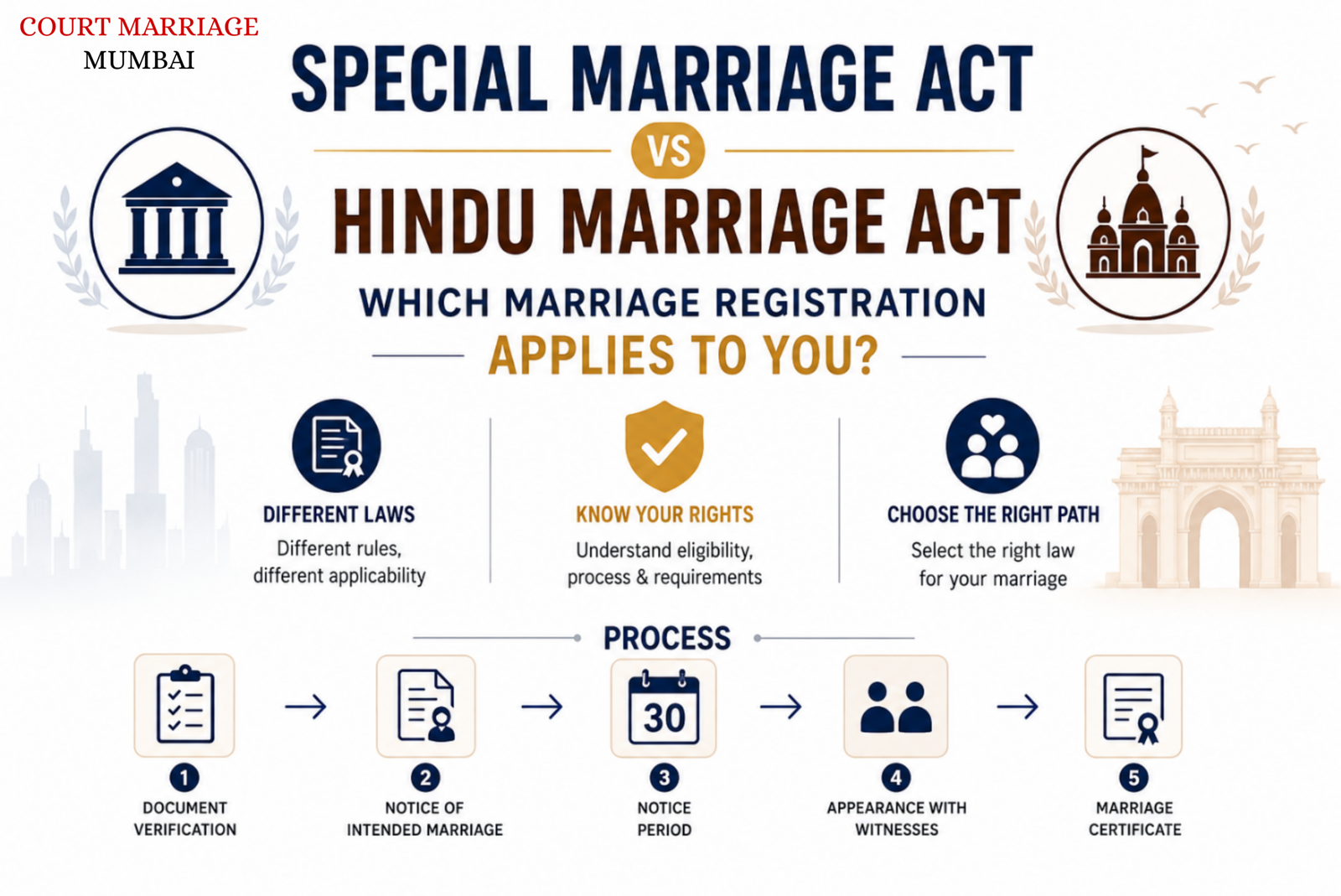
Choosing the correct legal route for marriage registration can be confusing, especially when couples are deciding between the Special Marriage Act, 1954 and the Hindu Marriage Act, 1955. The right option depends on factors such as the religion of the couple, whether a traditional marriage ceremony has already taken place, and whether the couple wants to solemnize their marriage through a Marriage Officer.
For couples planning Court Marriage in Mumbai, understanding the difference between these two laws can make the registration process easier and help avoid unnecessary delays.
This guide explains the key differences between the Special Marriage Act and Hindu Marriage Act and helps you understand which route may be appropriate for your situation.
The Special Marriage Act, 1954 (SMA) provides a legal framework for civil marriages between eligible couples, including couples who do not share the same religion. It allows a marriage to be solemnized before a Marriage Officer without requiring a religious wedding ceremony.
The Act specifies conditions relating to age, existing marital status and prohibited relationships, among other requirements.
This makes the Special Marriage Act particularly relevant for couples looking for a court marriage in Mumbai, including eligible interfaith couples.
The Act can apply when:
· The couple meets the statutory eligibility conditions.
· Neither person has a living spouse.
· The groom is at least 21 years old and the bride is at least 18 years old.
· The couple is not within the prohibited degrees of relationship, subject to applicable exceptions.
· The couple wants to solemnize their marriage through the civil procedure provided by the Act.
The Special Marriage Act also contains a separate mechanism for registering certain marriages that have already been solemnized in another form, subject to statutory conditions.
The Hindu Marriage Act, 1955 (HMA) governs marriages between persons to whom the Act applies. It provides rules concerning the conditions and ceremonies of Hindu marriages and also provides for registration of Hindu marriages.
Under Section 7, a Hindu marriage may be solemnized according to the customary rites and ceremonies of either party. Where the ceremony includes Saptapadi, the marriage becomes complete and binding upon the taking of the seventh step.
Section 8 deals with registration of Hindu marriages and is intended, among other things, to facilitate proof of the marriage.
Here is a simplified comparison:
Factor | Special Marriage Act | Hindu Marriage Act |
Main purpose | Civil marriage and registration under the Special Marriage Act | Governs Hindu marriages and their registration |
Religious ceremony | Not required for a marriage solemnized under the civil procedure | Marriage is generally solemnized according to applicable Hindu customs and ceremonies |
Interfaith couples | Can be applicable | Generally not the usual route for an interfaith marriage unless the parties fall within the Act’s scope |
Marriage Officer | Central to the civil solemnization procedure | Registration is handled under the applicable registration framework |
Traditional wedding already performed | Certain marriages may be registered under the Act subject to conditions | Registration can follow a marriage solemnized under applicable Hindu ceremonies |
Age condition | Male 21 and female 18 under Section 4 | Conditions are prescribed under Section 5 |
Notice procedure | Statutory notice procedure applies to a marriage intended to be solemnized under the Act | The procedure differs and depends on the applicable marriage-registration framework |
The exact procedure, documents, fees and local administrative requirements can vary, so couples should verify the current requirements with the relevant authority before submitting an application.
There is no universally “better” Act. The appropriate law depends on the circumstances of the couple.
Special Marriage Act may be relevant when:
· The couple wants a civil marriage without a religious ceremony.
· The couple is from different religions.
· The couple wants to solemnize the marriage before a Marriage Officer.
· The couple meets the eligibility requirements under the Special Marriage Act.
Hindu Marriage Act may be relevant when:
· Both parties fall within the scope of the Hindu Marriage Act.
· The marriage has been solemnized according to applicable Hindu customs and ceremonies.
· The couple wants to register that marriage under the applicable registration procedure.
Therefore, choosing between the two should not be based simply on which process appears faster. The couple’s circumstances and the legal basis of the marriage are more important.
The terms are often used interchangeably, but they are not exactly the same concept.
A court marriage generally refers to a civil marriage solemnized through the statutory procedure before the Marriage Officer. The Special Marriage Act provides the legal framework for this type of marriage.
A marriage registered after a traditional Hindu ceremony is different because the marriage has already been solemnized according to applicable Hindu rites, with registration serving as legal documentation of that marriage.
Understanding this distinction can help couples choose the correct application route.
Eligible Hindu couples can marry under the Special Marriage Act if they satisfy its statutory requirements.
Choosing the Special Marriage Act means following the civil-marriage procedure established under that Act rather than relying on a traditional Hindu marriage ceremony as the basis for solemnization.
Couples should consider their personal circumstances and the legal consequences before deciding which route to use.
The Hindu Marriage Act is specifically concerned with marriages to which the Act applies. For an interfaith couple who does not fall within its scope, the Special Marriage Act may provide the appropriate civil-marriage route.
Because religious status and individual circumstances can affect the applicable law, couples should obtain appropriate legal guidance before filing their application.
The exact document list can vary depending on the procedure and local authority. Couples may commonly be asked to provide documents relating to:
· Identity proof
· Age proof
· Address or residence proof
· Passport-size photographs
· Affidavits or declarations where applicable
· Proof of marital status where required
· Divorce decree or death certificate of a previous spouse, where applicable
· Witness identification and address documents
· Marriage photographs or ceremony-related documents where registration follows a traditional marriage
It is important to check the current requirements before visiting the registration office because incomplete or inconsistent documentation can cause delays.
One of the major differences couples should understand is the notice procedure under the Special Marriage Act.
Section 5 provides for a notice of intended marriage, while Sections 6 and 7 deal with the Marriage Notice Book and publication of the notice and objections.
This means couples should not assume that every Special Marriage Act marriage can be completed immediately after submitting documents.
The actual timeline can depend on the statutory procedure, the Marriage Officer’s jurisdiction, documentation and whether any objection is raised.
If a couple has already married according to applicable Hindu customs, registration is different from solemnizing a new civil marriage.
Section 8 of the Hindu Marriage Act provides for registration of Hindu marriages, with the purpose of facilitating proof of the marriage.
In Maharashtra, the applicable state registration framework also contains requirements concerning submission of a marriage memorandum, appearance of the parties and witnesses, verification and issuance of the registration certificate.
Therefore, couples who have already had a traditional wedding should generally examine the marriage-registration route rather than automatically applying for a fresh civil solemnization.
A simple way to think about it is:
Planning a civil marriage without a traditional ceremony?
The Special Marriage Act may be the relevant route if you satisfy its conditions.
An interfaith couple planning a civil marriage?
The Special Marriage Act may provide the appropriate legal framework.
Already married through applicable Hindu ceremonies?
The Hindu Marriage Act and applicable state registration rules may be relevant for registration.
Not sure which route applies?
Review your religion, marital status, residence, previous marriage history and whether a ceremony has already taken place before choosing the application procedure.
Why Legal Guidance Can Help
Marriage registration involves legal documents, statutory conditions and administrative procedures. A small mistake in documentation or choosing an inappropriate registration route can result in additional visits or delays.
Professional legal guidance can help couples:
· Understand which marriage law may apply
· Review documentation
· Identify missing documents
· Prepare required declarations or affidavits
· Understand the applicable procedure
· Coordinate witness requirements
· Avoid common documentation errors
For couples seeking Court Marriage in Mumbai, getting the process clarified before submitting an application can save time and reduce confusion.
1. What is the difference between the Special Marriage Act and Hindu Marriage Act?
The Special Marriage Act provides a civil-marriage framework that can be used by eligible couples, including certain interfaith couples. The Hindu Marriage Act governs marriages to which that Act applies and provides rules for Hindu marriage ceremonies and registration.
2. Can an interfaith couple get married under the Special Marriage Act?
Yes, the Special Marriage Act is designed to provide a civil-marriage route for eligible couples irrespective of religion, subject to the statutory conditions.
3. Can two Hindus marry under the Special Marriage Act?
Eligible couples can choose the Special Marriage Act if they satisfy its statutory conditions. The appropriate route depends on their circumstances and the type of marriage they intend to solemnize.
4. Is a religious ceremony necessary under the Special Marriage Act?
A religious ceremony is not required for a marriage solemnized through the civil procedure under the Special Marriage Act.
5. Can a Hindu marriage be registered after the wedding?
Yes. Section 8 of the Hindu Marriage Act provides for registration of Hindu marriages, subject to the applicable rules and requirements.
6. Is court marriage the same as marriage registration?
Not necessarily. A civil marriage solemnized under the Special Marriage Act and registration of a marriage that has already been solemnized are different legal procedures.
7. What is the minimum age for court marriage under the Special Marriage Act?
Section 4 of the Special Marriage Act specifies that the male must have completed 21 years and the female 18 years, subject to the other statutory conditions.
8. Can a couple get married under the Special Marriage Act without parental consent?
Where both parties are adults and meet the statutory conditions, parental consent is not listed as a condition for solemnization under Section 4 of the Special Marriage Act.