
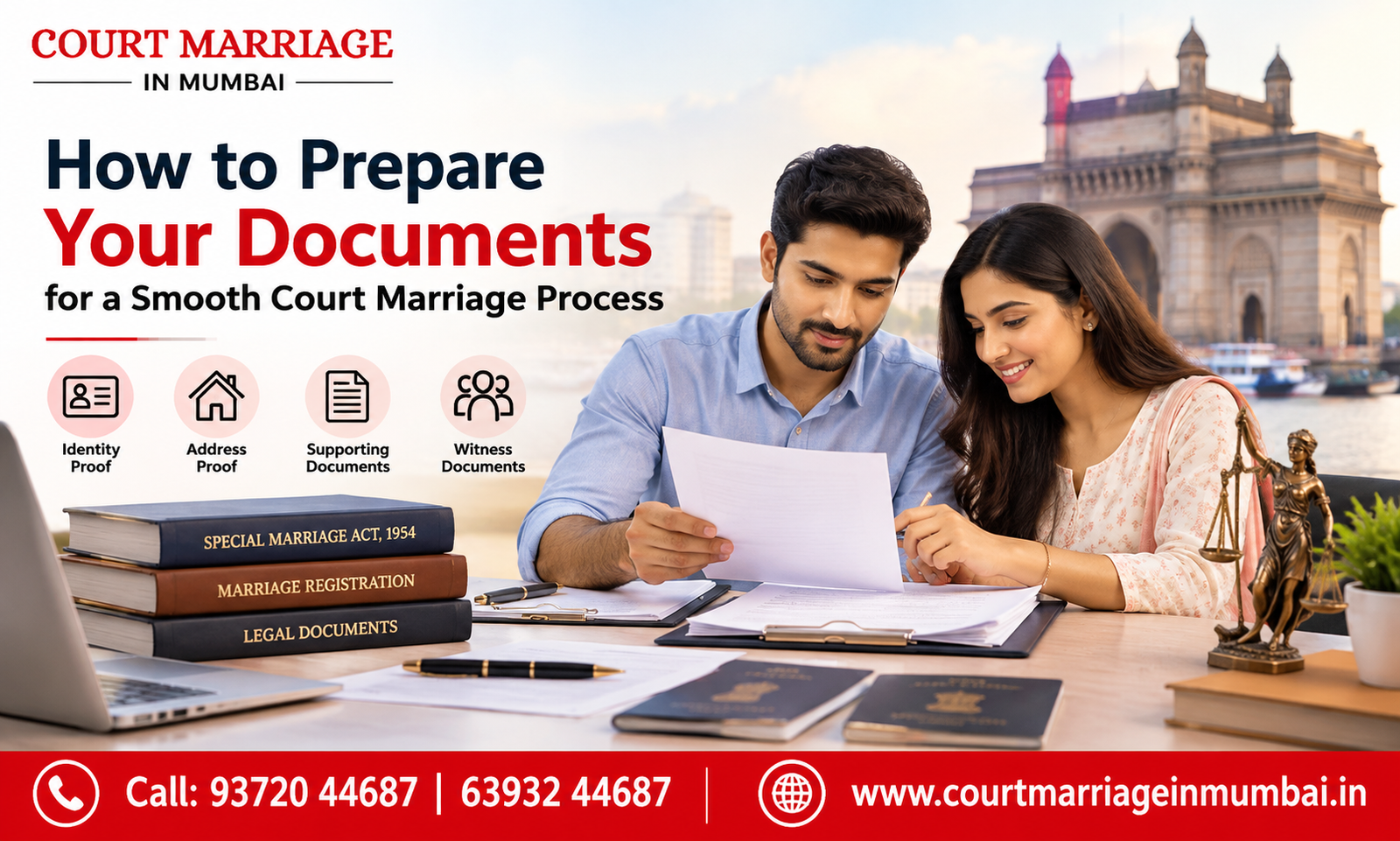
Preparing documents correctly is one of the most important steps before applying for court marriage. Even when a couple meets the legal eligibility requirements, incomplete paperwork, inconsistent personal information or missing supporting records can create avoidable difficulties during verification.
Understanding how to prepare documents for court marriage helps couples identify discrepancies early, arrange the necessary paperwork and approach the Marriage Officer with greater confidence.
For couples planning marriage in Mumbai, Maharashtra, preparation should begin with identifying the applicable marriage procedure and confirming the requirements of the relevant authority. Documents may differ depending on whether the couple is seeking solemnization under the Special Marriage Act, 1954, or registration of an existing marriage.
This guide explains how to verify, organize and review your documents, prepare witness records and avoid common paperwork mistakes before proceeding with your application.
Court marriage documentation serves several important purposes, including establishing identity, age, residence and eligibility to marry.
During verification, the Marriage Officer may examine submitted information and supporting documents to determine whether the applicable legal requirements have been met.
Problems can arise when:
Careful court marriage paperwork preparation helps identify these issues before submission.
For couples considering court marriage in Mumbai, checking documentation in advance can also make communication with the relevant Marriage Officer more efficient.
The most practical approach is to review each category of paperwork separately and organize the documents according to their purpose.
Before collecting documents, determine which legal procedure applies to your circumstances.
A fresh marriage solemnized under the Special Marriage Act, 1954 is different from registering a marriage that has already been celebrated through religious or customary ceremonies.
Under the Special Marriage Act, the parties ordinarily give notice to the Marriage Officer, followed by a statutory 30-day notice period before solemnization, subject to the applicable legal requirements.
The Act also contains provisions concerning registration of marriages celebrated in other forms. Other marriage registration laws may apply depending on the circumstances.
This distinction matters because the required application forms, declarations, supporting records and verification procedures may differ.
Couples should therefore confirm whether they need fresh solemnization or registration of an existing marriage before preparing their paperwork.
For further procedural information, refer to Special Marriage Act registration.
Identity and age documents should be reviewed carefully before submission.
Check whether the documents clearly display the applicant’s full name, date of birth and other relevant identifying information.
Pay particular attention to:
For example, if an applicant’s surname is spelled differently across two records, the discrepancy should be identified before the application is submitted.
Do not assume that every discrepancy requires the same correction or supporting document. The appropriate solution depends on the records involved and the Marriage Officer’s requirements.
Address verification is especially important for applications under the Special Marriage Act.
Under Section 5 of the Act, at least one party must have resided within the district of the Marriage Officer for not less than 30 days immediately preceding the date of giving notice.
Therefore, couples should check that their residence information is accurate and that their supporting records are suitable for the applicable jurisdiction.
Review the following details:
For applicants living in Mumbai, the location of the relevant Marriage Officer should be determined according to the applicable jurisdictional requirements, not merely convenience.
If the address on an identification document differs from the current residence, ask the appropriate authority what supporting evidence may be accepted.
Photographs and supporting records should be prepared according to the specifications communicated by the relevant Marriage Officer.
Before visiting the office, confirm whether photographs are required, their prescribed size and the number of copies.
Avoid submitting photographs that are blurred, damaged or inconsistent with the applicable requirements.
Additional records may be needed depending on the couple’s circumstances, such as nationality, marital history or the particular registration procedure.
Instead of collecting unnecessary paperwork, prepare documents based on a verified list for your application.
A basic court marriage document checklist can help with identifying the required categories, but it should be supplemented by careful verification of each record.
Witness preparation is another important part of the process.
For solemnization under the Special Marriage Act, the marriage is solemnized in the presence of three witnesses, who also sign the marriage certificate along with the parties and the Marriage Officer.
Couples should coordinate with their witnesses before the scheduled solemnization.
As part of preparing witness documents for court marriage, confirm:
Witnesses should understand when and where they are required to attend.
Avoid assuming that witness requirements are identical for every type of marriage registration.
The legal eligibility of both parties must be considered when preparing the application.
For a fresh marriage under the Special Marriage Act, neither party may have a living spouse at the time of marriage.
Applicants who were previously married may therefore need relevant records demonstrating the legal termination of the earlier marriage.
Depending on the circumstances, these may include a final divorce decree or the death certificate of a former spouse.
Not every applicant needs these documents.
Couples should ensure that any applicable records are complete, legible and appropriate for the procedure. Where a foreign judgment or overseas document is involved, additional legal or documentary considerations may arise.
One of the most useful parts of court marriage document verification is comparing the information across all records.
Check the spelling of names, dates of birth, residence details and other information entered into the application.
For example, one document may contain a middle name while another uses only an initial. A minor variation may be explainable, but applicants should not assume that every mismatch will be accepted automatically.
If a discrepancy exists:
Never alter an official document yourself or submit misleading information to make records appear consistent.
Knowing how to organize court marriage documents can make the verification process more manageable.
A practical approach is to maintain separate folders for each applicant and another for witnesses or supporting records.
Within each folder, arrange documents by purpose rather than mixing everything together.
For example, identity records can be placed first, followed by age proof, residence records and any case-specific documents.
Keep original documents safely and prepare clear photocopies where required.
Digital copies can also be useful for preliminary review and record management. However, digital files should not be treated as replacements for originals unless the authority expressly permits them.
Store scans securely because identification and marital-status documents contain personal information.
Many paperwork difficulties can be prevented through a careful review before filing.
Using inconsistent personal details
Names, initials or dates may differ between documents and application forms. Compare all information before submission and seek clarification where needed.
Submitting unclear copies
Poorly scanned or damaged records may be difficult to verify. Prepare readable copies that show the complete document.
Assuming every procedure has identical requirements
Fresh solemnization and registration of an existing marriage are legally distinct processes. Confirm the applicable requirements before collecting supporting records.
Ignoring witness preparation
Witnesses may be available in principle but unable to attend on the required date. Confirm their availability and documentation in advance.
Relying on outdated information
Online guides may not reflect current administrative requirements. Verify important details with the appropriate Marriage Officer.
Leaving corrections until the final stage
Where a record contains an error, resolving it early may prevent additional visits or requests for clarification.
Avoiding these common mistakes in court marriage documents can help couples approach the process with better preparation.
Couples planning court marriage registration in Mumbai should pay particular attention to residence details, jurisdiction and the specific procedure applicable to their circumstances.
Mumbai includes different administrative areas, and the appropriate authority must be identified according to the governing rules.
Applicants should confirm where notice or registration documents must be submitted and whether any additional verification is required.
For couples seeking documents needed for court marriage in Mumbai, the focus should be on obtaining the correct requirements from the relevant authority rather than relying solely on general online lists.
Couples exploring NRI court marriage in Mumbai may face additional documentation questions involving overseas residence, nationality, marital status or foreign-issued records.
For example, an applicant may need to establish how a foreign document can be accepted for the relevant Indian procedure.
Translation, authentication or apostille requirements may arise depending on the document and its intended use, but these should not be assumed to apply universally.
Similarly, NRI court marriage registration in Mumbai may involve different considerations depending on whether the marriage is being solemnized in India or an existing marriage is being registered.
For more information, explore NRI marriage registration.
Before attending an appointment or submitting an application, complete this final preparation review:
This preparation review is intended to reduce avoidable errors. It does not replace the official requirements of the Marriage Officer.
To prepare documents for court marriage, first identify the applicable marriage procedure. Verify identity, age, residence and marital-status information, then organize the required supporting records. Check for discrepancies, prepare witness details and confirm the current documentary requirements with the relevant Marriage Officer before submitting your application.
Applicants should be prepared to present original documents where required by the Marriage Officer. Photocopies or digital scans may be useful for preliminary review, but they are not automatically accepted as substitutes for originals. Confirm which documents must be produced physically before attending the office.
If your name differs across documents, identify whether the difference involves spelling, initials, surname changes or an actual error. The appropriate correction or supporting clarification depends on the circumstances. Contact the relevant authority before submission rather than assuming that a discrepancy will be accepted.
Confirm the number of witnesses required for your procedure and check which identification records the authority accepts. For solemnization under the Special Marriage Act, three witnesses must be present. Ensure that they understand their role, have the required documentation and can attend on the scheduled date.
Yes. Residence information is particularly relevant to notice filing under the Special Marriage Act. At least one party must satisfy the statutory residence requirement connected with the Marriage Officer’s district. Applicants should verify their address details and confirm which supporting documents the relevant authority accepts.
Unclear photocopies can make it difficult to verify names, photographs, dates and other essential information. Applicants should prepare readable copies showing the complete document. If a record is damaged or difficult to read, ask the appropriate authority whether a replacement or additional supporting document is necessary.
A person who was previously married may need to provide a final divorce decree establishing that the earlier marriage has legally ended. Additional requirements can depend on the applicable procedure and whether the divorce was granted in India or abroad. The relevant authority should confirm which records are acceptable.
Yes. Secure digital copies can make preliminary document review and record management easier. Use clear scans, descriptive filenames and restricted-access storage. However, electronic copies do not necessarily replace original documents or officially required physical submissions. Follow the Marriage Officer’s instructions regarding accepted document formats.
Begin reviewing documents well before the intended application date. The preparation period depends on whether records need correction, replacement, translation or other verification. For fresh solemnization under the Special Marriage Act, also account for the statutory notice procedure rather than treating document readiness as confirmation of an immediate marriage date.
Yes. The documentation for fresh marriage solemnization under the Special Marriage Act may differ from the requirements for registering a marriage already celebrated under another applicable law. Nationality, residence and marital history can also affect supporting documentation. Always confirm the requirements for your specific circumstances.
Understanding how to prepare documents for court marriage involves more than collecting identity cards and photographs. Accurate personal details, suitable residence records, properly coordinated witnesses and clearly organized supporting documents all contribute to a better-prepared application.
Couples should verify the correct marriage procedure, address discrepancies early and follow the documentary requirements communicated by the relevant Marriage Officer.
For those seeking guidance on document preparation, Pandey & Associates provides assistance with understanding applicable marriage documentation and registration formalities in Mumbai.
You can contact Pandey & Associates for a preliminary review of your document requirements before proceeding with the relevant authority.