
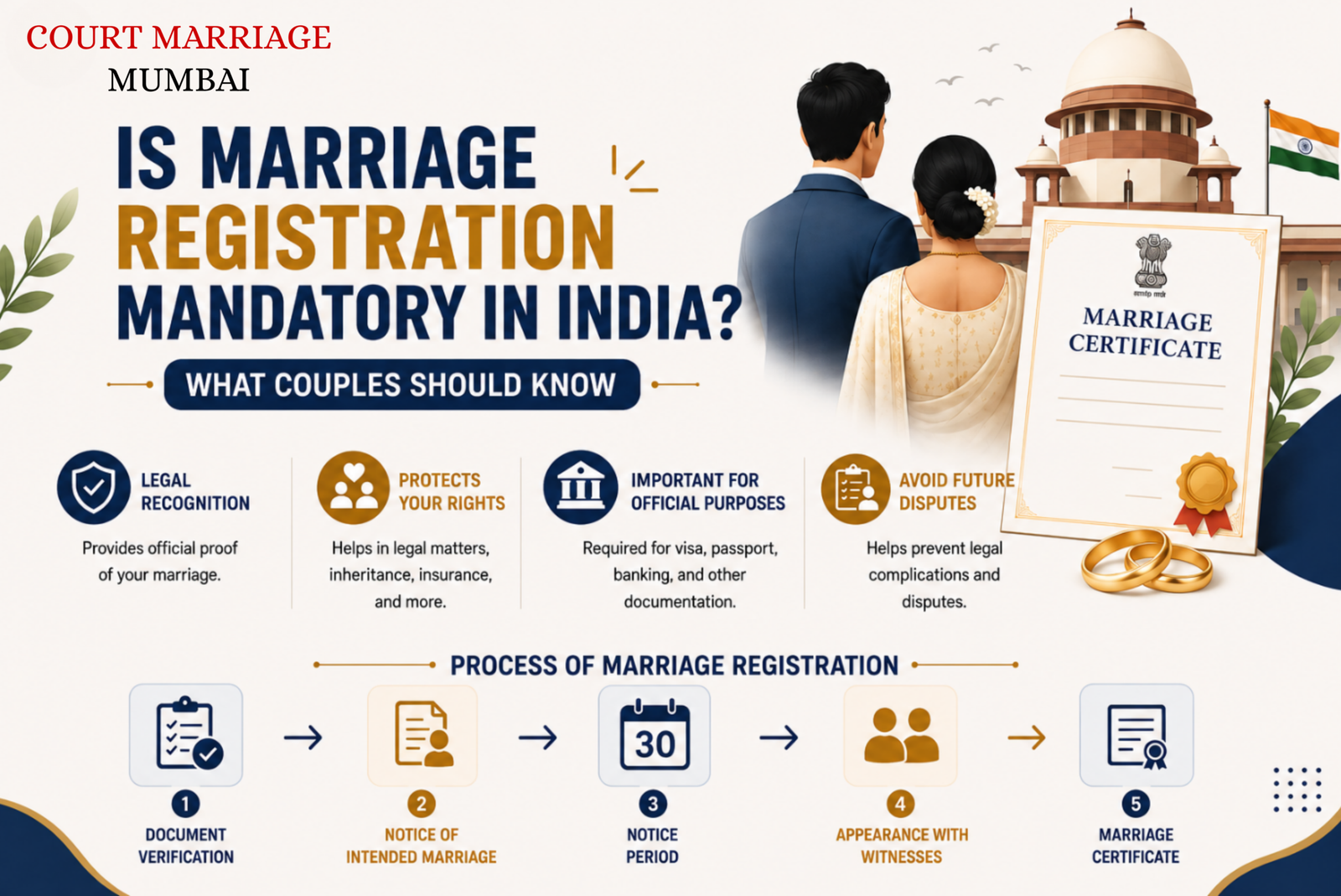
Marriage is an important legal and personal milestone, but many couples are unsure about one question: Is marriage registration mandatory in India?
The answer is not simply “yes” or “no.” Marriage laws in India operate through different central and state laws, and the registration requirements can depend on the type of marriage, the applicable personal law and the rules of the state where registration takes place.
For couples planning Court Marriage in Mumbai or looking to obtain a marriage certificate after a traditional wedding, understanding these rules is important.
This guide explains the legal position, why registration matters, which laws may apply and what couples in Mumbai should know before starting the process.
What Is Marriage Registration?
Marriage registration is the legal process of recording a marriage with the appropriate government authority and obtaining an official marriage certificate.
The certificate serves as documentary evidence of the marriage and can be useful when dealing with government departments, banks, immigration authorities, insurance companies and other institutions.
Marriage registration should be distinguished from the act of solemnizing a marriage. In some situations, the marriage is performed first and subsequently registered. In other situations, such as a civil marriage under the Special Marriage Act, 1954, the statutory procedure itself provides for solemnization before a Marriage Officer and issuance of a certificate.
There is no single nationwide rule that makes every marriage subject to exactly the same registration procedure.
The legal position depends on the law applicable to the marriage and the relevant state rules.
For example, Section 8 of the Hindu Marriage Act, 1955 allows state governments to make rules for registration of Hindu marriages and also permits registration to be made compulsory in a state or specified area. Importantly, the section also states that omission to register does not by itself affect the validity of a Hindu marriage.
The Supreme Court has also emphasized the importance of marriage registration and directed states and Union Territories to establish procedures for compulsory registration.
Therefore, couples should check the specific registration requirements applicable to their marriage and state rather than assuming that one rule applies identically throughout India.
Even where the legal consequences of non-registration may vary, obtaining a marriage certificate is extremely valuable.
A registered marriage provides official documentary evidence of the relationship and can make several future processes easier.
A marriage certificate may be required or useful for:
· Applying for a spouse visa
· Immigration and overseas documentation
· Updating government records
· Insurance and nominee-related matters
· Opening or updating certain financial records
· Applying for family-related benefits
· Passport-related procedures
· Property and inheritance-related documentation
· Establishing marital status before authorities
· Legal proceedings involving marital rights
For this reason, couples should generally consider registration an important legal and administrative step even where the applicable law does not make registration a condition of marriage validity.
The Supreme Court of India has repeatedly recognized marriage registration as an important safeguard.
In Seema v. Ashwani Kumar, the Supreme Court directed states and Union Territories to put appropriate mechanisms in place for registration of marriages. The Court highlighted registration as an important measure for protecting individuals and providing reliable evidence of marital status.
The practical implementation of registration requirements, however, depends on the applicable laws and rules.
This is why couples should identify the correct registration route before submitting documents.
The Hindu Marriage Act, 1955 contains specific provisions concerning Hindu marriages and their registration.
Section 7 deals with ceremonies for a Hindu marriage, while Section 8 deals with registration.
Section 8 provides a framework through which the particulars of a Hindu marriage can be entered into a marriage register according to prescribed rules. State governments can also make registration compulsory in the circumstances specified by the applicable rules.
Therefore, couples who have already completed a Hindu marriage ceremony should understand the applicable registration process rather than assuming that they need to solemnize another marriage.
The Special Marriage Act, 1954 provides a separate civil-marriage framework.
The Act contains provisions covering:
· Conditions for solemnization
· Notice of intended marriage
· Publication of notice
· Objections
· Declaration by parties and witnesses
· Solemnization
· Marriage certificate
· Registration of certain marriages celebrated in other forms
These procedures are specifically set out in the Act.
For couples seeking a Court Marriage in Mumbai, understanding whether the Special Marriage Act applies to their circumstances is particularly important.
A marriage certificate is an important official record of a marriage.
However, couples should distinguish between proof of marriage and the legal requirements for a marriage to be valid.
For example, Section 8 of the Hindu Marriage Act specifically describes registration as being for facilitating proof of Hindu marriages and states that omission from the register does not by itself affect the validity of the marriage.
The exact legal effect depends on the law under which the marriage was solemnized or registered.
Hindu couples should not rely on a general statement that registration is either always mandatory or always optional.
Section 8 of the Hindu Marriage Act permits state governments to prescribe rules and, where considered necessary, make registration compulsory in a state or specified area.
Therefore, couples should check the rules applicable in their state and their particular circumstances.
For couples in Mumbai, it is advisable to verify the current Maharashtra registration requirements before submitting an application.
A civil marriage under the Special Marriage Act follows a statutory procedure involving a Marriage Officer, and the Act provides for a marriage certificate after solemnization.
This is different from simply taking a traditional marriage ceremony and later registering it.
If you are planning Court Marriage in Mumbai, you should first determine whether you are:
1. Planning to solemnize a civil marriage under the Special Marriage Act, or
2. Registering a marriage that has already been solemnized under another applicable law.
The documents and procedure can differ.
The consequences depend on the applicable law and state rules.
In some circumstances, non-registration may create a documentation problem rather than automatically making an otherwise valid marriage invalid.
For example, Section 8(5) of the Hindu Marriage Act states that omission to make the registration entry does not affect the validity of a Hindu marriage.
However, not having an official marriage certificate can make it significantly harder to prove the marriage during administrative or legal processes.
This is one of the main reasons couples should not delay registration unnecessarily.
1. Official Proof of Marriage
A marriage certificate provides formal documentary evidence of the marital relationship.
2. Easier Immigration Procedures
Many visa and immigration applications require documentary proof of marriage.
3. Useful for Financial Matters
A marriage certificate may be requested when dealing with certain banking, insurance, pension or nominee-related matters.
4. Helps With Government Records
The certificate can be useful when updating records after marriage.
5. Helps Avoid Future Disputes
An official record can make it easier to establish the existence and date of a marriage if a dispute arises.
6. Convenient for Overseas Use
Couples may need an official marriage certificate for foreign authorities, visa applications or other international documentation.
The exact requirements depend on the applicable registration procedure and local authority.
Commonly requested documents may include:
· Identity proof of both spouses
· Age proof
· Address or residence proof
· Passport-size photographs
· Marriage-related documents, where applicable
· Affidavits or declarations, where required
· Divorce decree, if either spouse was previously married
· Death certificate of a previous spouse, where applicable
· Identity and address proof of witnesses, where required
Couples should verify the current document requirements before submitting their application because requirements can vary depending on the registration route.
There is no single timeline applicable to every marriage registration in India.
The timeline can depend on:
· The law under which the marriage is being registered
· Whether the marriage has already been solemnized
· Availability of appointments
· Document verification
· Local authority procedures
· Whether statutory notice requirements apply
· Whether any objection or discrepancy arises
For this reason, couples should avoid relying on claims of a guaranteed same-day or one-hour registration without first confirming which legal procedure applies.
Couples in Mumbai should first identify the correct legal route before preparing their documents.
Depending on the circumstances, the process may involve:
Traditional marriage already completed → registration under the applicable marriage-registration framework.
Civil marriage planned → potentially a procedure under the Special Marriage Act.
Interfaith couple → the Special Marriage Act may provide the relevant civil-marriage framework, subject to its statutory conditions.
The correct process should be determined from the couple’s individual circumstances rather than simply choosing the fastest-looking option.
Choosing the Wrong Registration Procedure
Different marriage laws have different requirements. Selecting a procedure without understanding its legal basis can result in delays.
Submitting Incomplete Documents
Missing identity, address, age or supporting documents can lead to additional visits.
Assuming Registration Rules Are Identical Everywhere
Marriage registration is affected by central and state legislation and applicable rules.
Waiting Until a Certificate Is Urgently Needed
Many couples only discover the importance of a marriage certificate when applying for a visa, passport update or other official documentation.
Relying on Outdated Information
Government procedures and administrative requirements can change. Always confirm the current requirements before applying.
Is marriage registration compulsory for every couple in India?
Not under one identical nationwide procedure. The requirement depends on the applicable marriage law and state-specific rules. Section 8 of the Hindu Marriage Act, for example, allows state governments to make registration compulsory in specified circumstances.
Does an unregistered Hindu marriage automatically become invalid?
Not necessarily. Section 8(5) of the Hindu Marriage Act states that omission to register does not affect the validity of a Hindu marriage.
Is a marriage certificate important if registration is not compulsory?
Yes. It provides valuable documentary evidence of the marriage and can be important for immigration, financial, government and legal purposes.
Is court marriage the same as marriage registration?
No. A civil marriage solemnized under the Special Marriage Act and registration of a marriage that has already taken place can involve different procedures.
Can an interfaith couple register their marriage?
Eligible interfaith couples can use the civil-marriage framework under the Special Marriage Act, subject to its statutory conditions and procedure.
Do couples need witnesses for marriage registration?
Witness requirements depend on the applicable procedure. Couples should confirm the current requirements with the relevant registration authority before attending.
So, is marriage registration mandatory in India? The most accurate answer is that the requirement depends on the applicable marriage law and state-specific rules. There is no single registration procedure that applies identically to every marriage across India.
Even when non-registration does not automatically invalidate a marriage, obtaining an official marriage certificate can provide valuable proof and make many future legal and administrative processes easier.
If you are planning Court Marriage in Mumbai, getting clarity on the applicable law, documents and registration procedure before starting can help you avoid unnecessary delays and documentation problems.
Need guidance for marriage registration or Court Marriage in Mumbai? Understand the applicable legal procedure and documentation before submitting your application.